
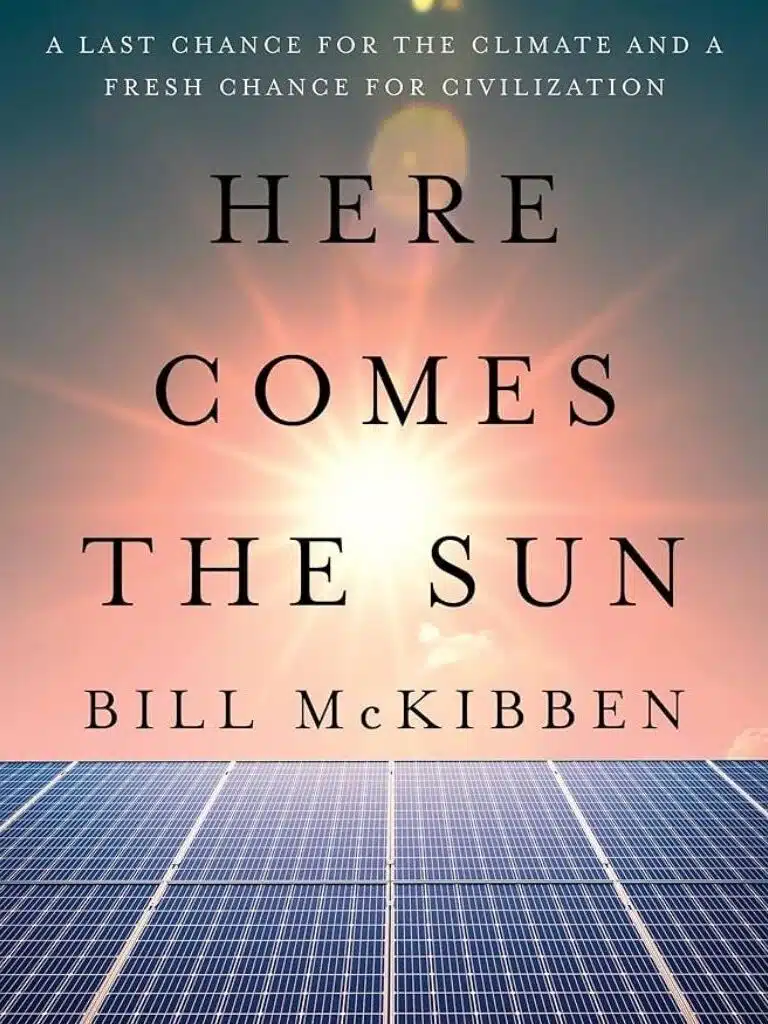
With reference to the famous Beatles’ song, Here Comes the Sun, ” McKibben paints the picture of a clean and abundant world tantalisingly within reach. The energy of the sun is now streaming through our solar panels and indirectly powering our wind turbines all over the world, he claims. This is an astounding, invigorating and hopeful book. You wish every politician and every company director in the world would read it. Everyone should. It is a manifesto for our new age.
We have all heard of the exponential energy curves sometime soon in our future. We have seen the pictures of New York in 1900 vs 1917. One car and dozens of carriages are present in the first. A few years later, dozens of cars and one horse-drawn carriage can be seen. That will be how the disruption of sustainable energy will work, we have been promised. McKibben is here to tell us that we are there, we are now on the steep part of the exponential curve for the adoption of solar and wind energy, and on the downwardly steep part of the curve for sustainable energy costs. Thanks in large part to China, but also to the governments and private enterprise, and individuals all over the world who have taken the opportunity to convert their energy sources, to put panels on roofs, to set up solar and wind farms, and to adapt the grid.
McKibben always takes the long view. He links our solar panels to humanity’s first control of fire, perhaps our one big difference from other animals. Now we are harnessing the power of the sun, the ultimate fire. The fires we need to eliminate are those caused by petroleum, gas, and coal.
The sun is always with us, he argues, and its use eliminates the need to move energy from one place to another, decreasing by 11% our energy needs just like that. He tells us that in the hottest days ever of June and July 2023, “humans passed a much more hopeful mark—for the first time we were putting up a gigawatt’s worth of solar panels every day.” By 2024, we were doing it every 18 hours (page 55). At the same time the cost of lithium storage has dropped by 97% in the last three decades (page 59).
McKibben talks about the exuberance of this moment, and the way in which novel things happen every day, when we reach this level of sustainable use (page 62). The book never loses its focus, but it is also full of funny, exhilarating and creative stories about how this energy is being harnessed and used.
The warning part of the title is also clear. Saving the planet is possible, because the sun is here, but it is not inevitable because of political interference and regulation that will thwart it and stop it. When I speak to young people, I always say that how you vote matters. That doesn’t necessarily mean you have to vote green. You could instead convince the National Party that sustainability is its highest priority. I also say that there are numerous and widespread careers and jobs that will help to bring this revolution about. The harnessing of the sun will include a revolution and interruption of life as we know it. There is much to do.
McKibben gives us every reason to hope and to welcome a future where the air will be clean, and energy abundant. One of the reasons this is such an exciting book is that it is not preaching a move from abundance to scarcity. McKibben is a Methodist and certainly does not advocate inequality, waste, or luxury, but nor does he see the future as one that uses substantially less energy than we do today. His vision is able to imagine a cleaner, quieter, more equal world, fueled by abundant energy from the sun, even if we never crack the nuclear fusion puzzle.
A part of the charm of this book is that McKibben loves life and all the good things that energy brings to our civilization. Even AI is not the deal breaker it is sometimes supposed to be, he argues. McKibben, I am sure, would not deny that greed is a ubiquitous human failing, but the healing of the planet does not require a sudden moral revolution on that score, nor does it require that ordinary human desires of an outward-looking species should suddenly be drastically curtailed.
The second part of the book examines all the arguments against his premise. He challenges the ideas that we cannot afford it, that poor countries can’t afford it, that we are running out of lithium and other minerals, and that we don’t have enough land.
His answers are stunning. It would take just $90 billion to install enough microgrids across Africa to power the continent (page 111). By comparison, it is interesting to note that this sum is not much more than the ICE budget for 2025. This just needs to happen, McKibben says, as a gift from a developed world that can well afford it. Regarding minerals, he says we are finding lithium in unusual places, but that batteries that run on sodium are just around the corner. Humans will find creative solutions if given the opportunity. The transition requires brain-power more than it does particular stuff.
But McKibben is also clear that we have this choice. Mining must happen, in order to stop the planet from being uninhabitable, starting from the hottest and poorest parts of the globe. This same argument applies to the land question. We will have acres of land given over to solar panels, but it turns out that many crops and animals enjoy a bit of shade and panels can be mixed with agriculture. And again, we have to raise energy production to a certain point. We don’t have to continue after that point, when the human population is predicted to fall rapidly.
This is the time to push, he says, to protect laws that allow this to happen and to discourage the regulations that are preventing the free movement up the exponential curve. This may be an exuberant book, but McKibben is also clear that we could easily fail, and by means that are now apparent in the world today.
The final chapter is of particular interest to Christians. McKibben is a person of faith, and in this chapter he talks about the need for the spirit response as well as all the hard facts. All the way through, he talks about how humans have always revered the sun. He encourages us to get in touch with our more primal natures, which have turned toward the sun and been filled with awe at what it produces. He talks about “the sense of light as a metaphor for the divine, the idea that God, like the sun, is a source of life and energy.” He reminds us that “the ‘Sun of Righteousness’ is the name that the Hebrew prophets used to forecast the Messiah” (page 195). In New Zealand we might think also of the idea of whakapapa, and the way in which light/sun can be layered backwards to a Creator source, and to the Son who came as the light of God.
He ends:
I end this book saddened, of course, by all that has happened in the last 40 years, and by all that we haven’t done. But I also end it exhilarated. Convinced that we’ve been given one last chance. Not to stop global warming but perhaps to stop it short of the place where it makes civilization impossible. And a chance to restart that civilization on saner ground, once we’ve extinguished the fires that now both power and threaten it (page 207).
McKibben has been writing and crusading all his life. Sometimes people write a book that is the result of deep knowledge, action, and spiritual reflection. This is such a book. We should all be reading it. We should all be renewing our wonder and love for the sun, as the source of our energy and life, and the metaphor for all our images of God and of love.